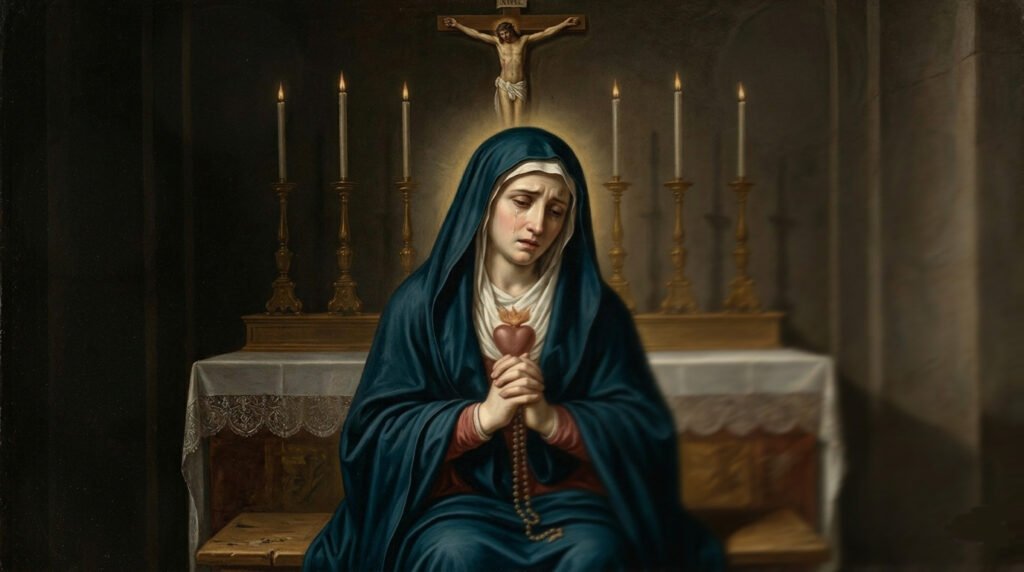
The concept of Mother Mary’s “silent suffering” is a profound theme in theology, art, and spirituality. It refers to her internalizing of pain and mystery—often described as “pondering these things in her heart”—rather than reacting with outward lamentation or protest.
1. The Biblical Root: “A Sword Shall Pierce Your Soul”
The foundation of her silent suffering begins early in the Gospel of Luke. During the Presentation in the Temple, the prophet Simeon tells Mary:
“And a sword will pierce your own soul too.”
This prophecy suggests that her life would be inextricably linked to the suffering of her son. Unlike other figures who argue with God or cry out for justice, Mary is consistently depicted as accepting these “swords” with a quiet, resilient faith.
2. The Seven Sorrows
In Christian tradition, Mary’s silent endurance is mapped through the Seven Sorrows, several of which highlight her quiet strength:
- The Flight into Egypt: Fleeing as a refugee to save her child.
- The Loss of the Child Jesus in the Temple: Three days of anxious searching.
- Meeting Jesus on the Way to the Cross: A brief, silent encounter amidst a violent crowd.
- Standing at the Foot of the Cross: This is the ultimate “silent” moment. While others fled, she remained present, witnessing the Agony without interference.
3. Stabat Mater: The Theology of Presence
The Latin hymn Stabat Mater (“The Mother was Standing”) captures the essence of this suffering.
- Active Silence: Her silence is not passive or weak; it is an active presence.
- Solidarity: She represents the “Companionship of Sorrow,” showing that sometimes the greatest act of love is simply staying with someone in their darkest hour when words are useless.
4. Artistic Representation: The Pietà
In art, specifically Michelangelo’s Pietà, Mary is often shown with a face that is remarkably calm despite holding her dead son.
- Dignity in Grief: This artistic choice emphasizes that her suffering was deeply internal.
- The “Yes” (Fiat): It reflects her original “Yes” to God—an acceptance of the entire journey, including the tragic end.